
Tensions between the United States and Iran are escalating again as Tehran signaled it will not remove its enriched uranium stockpile, while Washington has dramatically increased its military presence across the Middle East under the campaign known as “Operation Epic Fury.”
Iran’s Supreme Leader Ali Khamenei reportedly insisted that Iran’s enriched uranium will remain inside the country, further complicating already fragile ceasefire discussions. The statement comes as U.S. President Donald Trump warned that any collapse of the ceasefire could trigger a renewed military response.
According to a report by the Atlantic Council, the ongoing U.S. military buildup has become one of Washington’s largest regional deployments in recent decades. While the operation showcases American military strength, analysts warn it is also stretching the country’s long-term defense readiness.
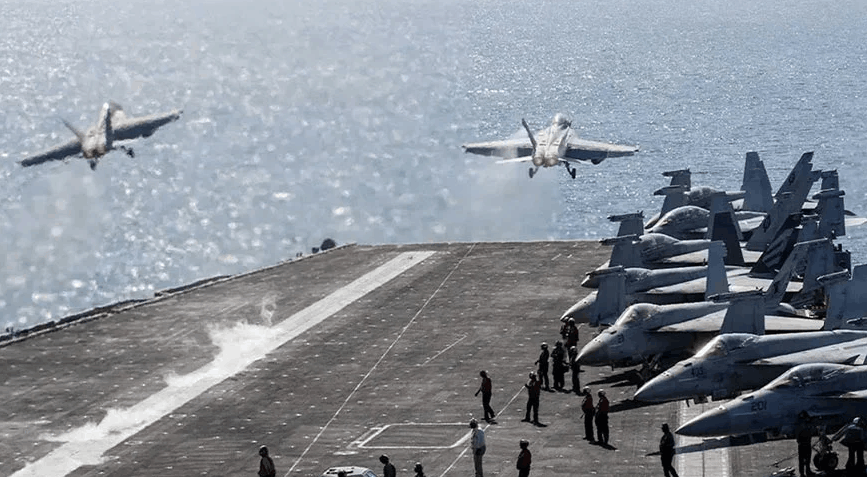
The U.S. Navy has deployed two of its three available aircraft carriers — the USS Abraham Lincoln and the USS George H. W. Bush — to the region. Meanwhile, the retirement of the USS Nimitz has reportedly been delayed until 2027 amid rising regional tensions.
Washington has also sent 18 Arleigh Burke-class destroyers, nearly one-third of the entire fleet, alongside amphibious assault ships including the USS Tripoli and USS Boxer. Mine-clearing vessels and littoral combat ships have also been activated over concerns that Iran could deploy naval mines in the Gulf.
In the air campaign, around 15 B-1 Lancer bombers are reportedly operating from bases in Britain, accounting for nearly 60 percent of the U.S. B-1 fleet. Stealth B-2 bombers have also been involved, although exact numbers remain classified.
The report says at least 16 MQ-9 Reaper drones have been destroyed in Iranian drone attacks. More than 100 aerial refueling aircraft, including KC-135 and KC-46 tankers, are currently supporting long-range missions across the region.
On the ground, troops from the U.S. Army’s 82nd Airborne Division have reportedly been deployed, while advanced long-range Precision Strike Missile systems are being used for deep-strike operations against Iranian-linked targets.
The U.S. has additionally strengthened missile defenses by deploying Patriot missile batteries in Saudi Arabia and Qatar, along with THAAD defense systems in Jordan and Israel. Analysts estimate the deployment represents nearly one-third of America’s overall missile defense capability.
Security experts warn that moving some missile defense systems from the Korean Peninsula to the Middle East could weaken U.S. preparedness against North Korea, raising concerns about Washington’s ability to manage multiple global flashpoints at the same time.

