
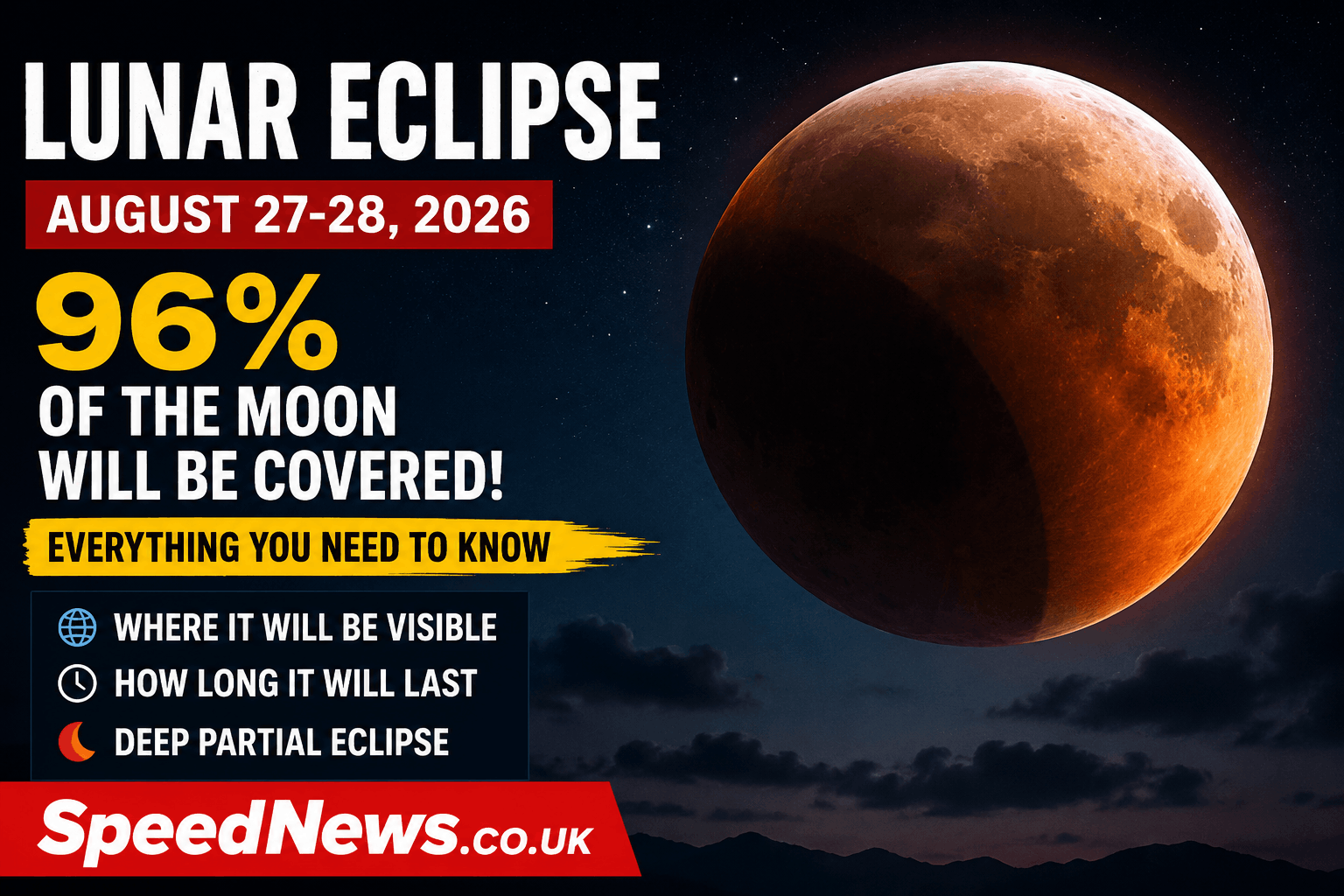
Skywatchers are in for a spectacular celestial event later this year as the final lunar eclipse of 2026 is set to take place on the night of August 27-28. Although it will be classified as a partial lunar eclipse, nearly the entire Moon will slip into Earth’s shadow, creating a dramatic sight across large parts of the world.
A lunar eclipse occurs when Earth moves directly between the Sun and the Moon, casting its shadow on the lunar surface. These events always take place during a full moon.
According to astronomical predictions, up to 96% of the Moon will be covered by Earth’s dark shadow during the peak of the eclipse. While it will fall just short of becoming a total lunar eclipse, the Moon is expected to take on a deep orange or reddish appearance, making it resemble a “Blood Moon.”
Where Will the Eclipse Be Visible?
The eclipse will be visible across much of North and South America, Europe, Africa, Greenland, Iceland, Scandinavia and parts of Antarctica.
Astronomers estimate that nearly 12% of the world’s population — around 987 million people — will be able to observe every stage of the eclipse. Another 1.3 billion people are expected to witness at least part of the event.
Read Also: Best Low-Interest Loans in the USA (2026): Get Approved Fast & Save Thousands
How Long Will It Last?
According to astronomical calculations, the entire eclipse event will last approximately 339 minutes from beginning to end. The Moon will remain partially immersed in Earth’s shadow for about 119 minutes during the most dramatic phase.
The eclipse is also notable because it will be the deepest partial lunar eclipse visible anywhere in the world since September 2014.
Astronomy enthusiasts are expected to closely follow the event as it offers one of the most impressive lunar displays of the year despite not reaching total eclipse status.


