
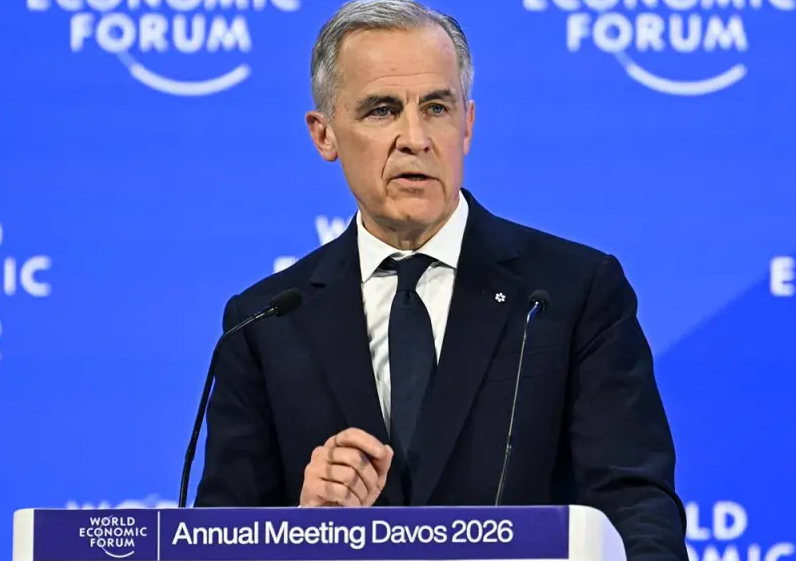
Canadian Prime Minister Mark Carney has pushed back against claims that he softened his stance following a phone conversation with US President Donald Trump, insisting he stands firmly by the comments he made at the World Economic Forum in Davos.
Speaking to reporters in Ottawa on Tuesday, Carney said his position had not changed and that he made this clear directly to President Trump during their call. His remarks came after US Treasury Secretary Scott Bessent suggested that Carney had “aggressively” walked back his Davos speech during the conversation.
Carney said the discussion with Trump was constructive and covered a wide range of topics, including global security, Ukraine, Venezuela, Arctic cooperation and trade relations between the two countries. He confirmed that trade under the US-Mexico-Canada Agreement was also part of the conversation.
Dispute Over Davos Remarks
The disagreement stems from Carney’s speech at the Davos summit, where he warned about the risks posed by unchecked global powers and suggested that the post-war international order was under strain. Although he did not name any country directly, his remarks were widely interpreted as a reference to the United States.
President Trump responded a day later at the same forum, stating that Canada “exists because of the United States,” a comment that drew widespread attention.
Carney rejected claims that he retreated from his comments during his call with Trump. He said his message in Davos was clear and that Canada was simply responding to changes in US trade policy. According to Carney, the president understood Canada’s position during their discussion.
US Officials Criticize Canada’s China Policy
US Treasury Secretary Scott Bessent criticized Canada’s recent trade engagement with China, saying he was surprised by Ottawa’s approach. He questioned the decision to ease certain trade barriers with Beijing while maintaining strong economic ties with the US.
Bessent also suggested that Canada should prioritize its relationship with Washington, noting that north-south trade between the two countries remains far more significant than trans-Pacific commerce.
His remarks followed comments by President Trump warning that Canada could face steep tariffs if Chinese goods were allowed to enter the US market through Canadian channels.
Trade Tensions and Tariff Concerns
Canada recently adjusted tariffs on some Chinese goods, including lowering duties on canola oil while maintaining restrictions on electric vehicles. Ottawa has stressed that it is not pursuing a free trade agreement with China and has no plans to do so.
Carney said the government’s actions should not be interpreted as a shift in policy. He added that Canada remains committed to its trade relationship with the United States and views Trump’s recent tariff warnings as part of broader negotiations ahead of the scheduled review of the USMCA agreement.
He described the US president as a tough negotiator and said current rhetoric should be seen in that context.

